


ВЕРА, РЕШИМОСТЬ, БЕСКОМПРОМИССНОСТЬ АКТИВНОЕ ДЕСЯТИЛЕТИЕ 1425-1434 (3)
ВЕРА, РЕШИМОСТЬ, БЕСКОМПРОМИССНОСТЬ
АКТИВНОЕ ДЕСЯТИЛЕТИЕ 1425-1434 (3)
FAITH, DETERMINATION, UNCOMPROMISING SPIRIT
A DECADE OF ACTION 1425-1434 (3)
АКТИВНОЕ ДЕСЯТИЛЕТИЕ 1425-1434 (3)
FAITH, DETERMINATION, UNCOMPROMISING SPIRIT
A DECADE OF ACTION 1425-1434 (3)
Read the English translation immediately after the Russian text below.
Это третье по счету десятилетие 60-летнего повторяющегося цикла изменения общественных настроений. Мы уже рассматривали его в статье Бурные десятилетия (3), опубликованной в конце 2024 года в дневнике «Форума» - https://forum.artinvestment.ru/blog.php?b=366601. Это особенно бурное десятилетие, известное тем, что именно в нем происходили события Великой французской революции, перевернувшие мир (в первый раз и через 60 лет во второй, 1785-1794 и 1845-1854), а также эпохальные два десятилетия русского (и интернационального) первого и «второго авангарда» (термин М. Гробмана) – 1905-1914 и 1965-1974.
(Цифра в скобках (3) означает порядковый номер десятилетия в 60-летнем цикле. Начинает цикл «активное» десятилетие, а заканчивает «медитативное». «Активных» десятилетий три – (1), (3), (5), идут под нечетными номерами, «медитативных» столько же (2), (4), (6), идут под четными номерами)
Все «активные» (авангардные) десятилетия (3)
Синим отмечены «рациональные» суперциклы
Черным – «чувственные»
Этап «Лето» (1405-2004)
1425-1434 1485-1494
1545-1554 1605-1614
1665-1674 1725-1734
1785-1794 1845-1854
1905-1914 1965-1974
Этап «Осень» (2005-2604)
2025-2034 2085-2094
Синим отмечены «рациональные» суперциклы
Черным – «чувственные»
Этап «Лето» (1405-2004)
1425-1434 1485-1494
1545-1554 1605-1614
1665-1674 1725-1734
1785-1794 1845-1854
1905-1914 1965-1974
Этап «Осень» (2005-2604)
2025-2034 2085-2094
Возвращаюсь к теме «авангардных» (3) («активных», «бурных», «действенных» и т.д. десятилетий) в связи с ее актуальностью, - уже второй год мы являемся не только современниками, свидетелями, но и участниками разыгрывающейся драмы и комедии этого неповторимого отрезка времени.
Здесь, как и ранее, искусство в целом и в частности живопись нужно рассматривать не как оживляющий иллюстративный материал, а как основополагающий, без которого нам не понять историческое время.
Правда, нужно оговориться, живопись обладает громадным количеством значений и смыслов, близким к бесконечности, поэтому без предварительного знания, без ключа и подсказки, без сжатия материала нам не обойтись. Для этого я использую трансляцию картины на вербальный язык, что позволяет выявлять, сопоставлять и сравнивать скрытые смыслы, значительно упрощая нашу задачу.
А теперь, просмотрев живопись, показанную ниже, сопоставим с только что минувшим «медитативным» десятилетием 1415-1424 годов, с характерной для него «Тишиной, медитацией, сосредоточенностью на внутреннем, гармонией, красотой, миром и смирением, принятием реальности, правдой чувства, нежностью, изысканностью и музыкальностью, тонкостью и воздушностью красок», проявившихся в знаменитой «Троице» А. Рублева.
Медитативное осмысляющее десятилетие (2) https://forum.artinvestment.ru/blog.php?b=367481
В рассматриваемом нами десятилетии меняется и тема его же работы – «Положение во гроб», и стилистика: - «Экспрессия, оплакивание, патетика, эмоциональный подъем». Но это изменение мы можем объяснить, уже хорошо известным нам чередованием «медитативных» и «активных» десятилетий. Кстати, мы можем еще раз убедиться в непреложности факта этого чередования, сопоставив с его более ранней росписью (1408 г.) «Богоматерь», с ее «экспрессией, порывом во вне, обобщением, эмоцией и движением», принадлежащей к первому (1) «активному» десятилетию 60-летнего цикла 1405-1414 годов.
Десятилетие русской живописи (1) 1405-1414 https://forum.artinvestment.ru/blog.php?b=367081
Но факт чередования «активных» и «медитативных» десятилетий нам уже известен. Сейчас нас интересует специфика различия между «активными» десятилетиями. В этом случае у нас есть очень удобный пример А. Рублева, представленного работами во всех трех, в том числе и в двух «активных» - (1) первом (1405-1414) и (3) третьем, рассматриваемом нами сейчас. Хотя обе работы в одинаковой степени активны и экспрессивны, но отличие бросается в глаза! На почти монохромной фреске первого десятилетия (1) Богоматерь, в канун «Страшного Суда» обращается к Иисусу Христу в качестве защитницы всех, т.е. абстрактного, безличного человечества. Ее движение крайне обобщено и отстранено, направлено в сторону Бога, невидимого Абсолюта. При общей динамике обеих работ, вторая его работа «Положение во гроб», выполненная через двадцать лет, кардинально отличается своей теплотой, поэтичностью, силой непосредственного, личного присутствия, переживания и веры. То есть, в первом (1) десятилетии взгляд на вещи надличный, отстраненный, рациональный, во втором, № (3) – индивидуальный, личный, чувственный, присутствующий здесь и сейчас. Мы можем убедиться в верности нашего наблюдения, еще на одном случае – присутствии в двух, интересующих нас десятилетиях скульптур Донателло. Если юный «Давид», с непропорционально большой отрубленной головой Голиафа у его ног в первом (1) «активном» десятилетии 1405-1414 годов, производит впечатление несколько неловко позирующего 20-летнего мальчика (ему самому в это время 23 года), представившего себя нереальным непобедимым героем, что является явной идеализацией и отстраненной холодноватой рационализацией, то выполненный в 1427 году (опять же через 20 лет!), в очередном «активном» десятилетии (3) барельеф «Пир Ирода», с его «смятением, всплеском эмоций, динамикой, экспрессией группы, охваченностью единым чувством и конвульсивным трепетом физического мира» - вводит нас, не столько «теплый», сколько раскаленный мир личного, непосредственного, чувственного, реального, а не идеального бытия. Как мы видим, в этих двух «активных» десятилетиях явно прослеживается чередование изменения стилистики искусства – от, в первом случае (1) (1405-1414) «безличного», «отстраненного», «рационального» и «идеального» стиля видения реальности, к «личному», «чувственному», «субъективному» во втором случае (3) (1425-1434). Итак, мы рассмотрели два из трех «активных» десятилетия 60-летнего цикла. Очередное будет идти под № (5) в 1445-1454 годах. Заглянув в него, мы узнаем специфику не только последнего «активного» десятилетия, но и их координацию друг с другом. В этом нам поможет уже знакомая фигура Донателло, с первым в Европе с времен античности, крупным конным «Памятником кондотьеру Гаттамелату», 1446-1453. Нужно отметить, что Донателло, не частый пример очень живой творческой личности. На наших глазах его искусство кардинально изменяется в очередной раз. На этот раз мы не видим «пульсации и кипения чувственной реальности», - напротив, здесь движение коня и всадника подчинено железной, рациональной и неукротимой воле. Композиция выверена и организована, ритмичная поступь коня неумолима, зависит от логики всадника, дисциплины, правил и законов природы. Поражает сходством стилистики сохранившаяся только на фотографии фреска этого же десятилетия Мантеньи, «Шествие св. Иакова на казнь», с «сильным ракурсом снизу, как фигур, так и архитектуры, монументальностью, равномерностью хода шествия, жесткой, рациональной расчерченностью зданий. Предлагаю также посмотреть выставленную мною в качестве аватара к статье об этом десятилетии работу Жана Фуке, «Богоматерь с младенцем», 1450 года, с ее «формализмом, контрастным сочетанием реальности и условности ярких цветных деталей фона, вызывающе обнаженной грудью и рациональной жесткостью и четкостью рисунка».
Все это позволяет нам утверждать, что в первом 60-летнем цикле, рассматриваемого нами этапа «Лета», во всех трех его «активных» десятилетиях происходит чередование стилистической окраски по принципу:
1. Десятилетие (1), (1405-1414), стиль - «безличный», «отстраненный», «рациональный», «идеальный»
2. Десятилетие» (3), (1425-1434), стиль - «личный», «чувственный», «субъективный»
3. Десятилетие (5), (1445-1454), стиль - «безличный», «отстраненный», «рациональный», «идеальный»
Сохраняется ли это чередование в других циклах? Будем рассматривать в следующих статьях…
Активное пост-авангардные десятилетия (5) https://forum.artinvestment.ru/blog.php?b=366721
Нужно отметить, что качества, чередующиеся в циклах, рассматриваются не как абсолютные, а в отношениях друг к другу, как «доминирующие» или «преобладающие» (пример – 600-летний этап «Лето» имеет в целом, по отношению к этапу «Осень», «рациональную» окраску, в нем находятся пять 120-летних гиперциклов, чередующихся от преобладания «рациональной» окраски (стилистики) до «чувственной» и т.д.)
1425-1434 – Активное десятилетие (первого шестидесятилетия 120-летнего рационального суперцикла) (3)
Мазаччо – Раннее возрождение, религиозная живопись, (1425) «На суровом, монохромном фоне многоцветная, декоративная, условно и формально выполненная, жестикулирующая группа» - (1426), «Сила духа, острота меча, резкая энергия и экспрессия складок одежды, подчеркнутых световым контрастом», «Агрессия, жестокость, драматизм, экспрессия, цветовой и световой контраст, динамика действия», «Жестокость, суровость, экспрессия, будничность и неумолимость исполнителей» - (1427), Рублев, «Экспрессия, оплакивание, патетика, эмоциональный подъем» - Мазаччо, «Изгнание из рая», «Экспрессия, меч в руке ангела, жесткость и неумолимость, дидактичность, ригоризм и рационализм» - Донателло, «Пир Ирода», «Смятение, всплеск эмоций, динамика, экспрессия группы, охваченность единым чувством, конвульсивный трепет физического мира» - (1428), Мазолино, «Лаконизм, суровость красок, жесткость, резкая прочерченность архитектуры» - (1430), Ян ван Эйк, «Движение вперед ради защиты великих христианских идеалов добра и справедливости» - Франке, «Патетический и экспрессивный хоровод оплакивающих и поклоняющихся Христу», - Алвару Пиреш, «Формальность, декоративность, экспрессия ангелов с музыкальными инструментами, поющих славу деве с младенцем» - (1431), Фра Анджелико, «Страшный суд», «Дидактизм, ригоризм, рационализм, множество мелких фигурок, реализм и условность» - (1433), Рогир ван дер Вейден, «Динамика и решительность, символизм и условность, тщательность и реализм деталей» - Фра Анджелико, «Агрессия толпы, драматизм и жестокость, чудо, гроза, град и тьма в разгар дня, мучители в страхе разбегаются» - Ян ван Эйк, «Драматическая взволнованность головного убора, трезвость, жесткость и проницательность взгляда, направленного на собеседника и на окружающий мир, вера в себя, активность и рациональность»
Исторический фон:
1425 - (Русь) (после 1425) – Гражданская война (20 лет) - Русь, эпидемия чумы (25-27) - Гуситские войны (1420-34) – Швейцария (Аппенцелльские войны) (1401-29) – Франция (гражданская война арманьяков и бургиньонов) (1407-35) - Турецко-венецианская война (1423-30) – Италия (Войны в Ломбардии) (1425-54) - Роялистский переворот Якова I в Шотландии (25) – Столетняя война между Англией и Францией (1337-1453) (116 лет) (ее часть Ланкастерская война - в 1415-53 гг) – 1426 - Англия, «Парламент дубинок» (запрет ношения оружия) – Датско-Ганзейская война (по 35) – Поход Витовта на Псков - Победа таборитов при Аусиге (гуситы) – 1427 - Берн (инквизиция в Швейцарии), первые процессы по «охоте на ведьм», изгнание еврейской общины – Гуситы разгромили крестоносцев – Литва завладела Тулой - Чума на Руси – Тур (Франция) начало строительства собора (пламенеющая готика) – Завоевание Вьетов Китаем – 1428 - Жанна д'Арк, идея освобождения страны (осада Орлеана англичанами) (по 29) - Закончилась гражданская война в Марокко (с 20 г.) - Образование Узбекского ханства – Образование Крымского ханства (по 30 г.) – Россия, конец эпидемии чумы (с 17 г.) - Самарканд, строительство Улугбеком Обсерватории – 1429 - (Франция) – Жанна д’Арк (слышит голоса) – Патриотизм. Под ее руководством французы побеждают (эпизод столетней войны 1337-1453) – Снята осада Орлеана (с 28) – Швейцария, закончились Аппенцелльские войны (с 1401) - Крестовые походы против гуситов (с 20-34 гг) – Русь, набеги ордынцев - (Париж) – чтение проповеди 10 дней подряд (на кладбище невинно убиенных младенцев, около изображения «Пляски смерти», на фоне груды черепов) – 1430 - Пленение Жанны д’Арк – Победа гуситов над армией Сигизмунда - (Польша) – трон стал выборным – Литва, смерть Витовта – Русь, экстремальная засуха, масштабные лесные и торфяные пожары, массовый голод – Русь, князь Юрий Дмитриевич выступает против Василия II Тёмного, занимает Новгород - Восстание крестьян в Трансильвании и в Северной Венгрии - Флорентийский собор – начинают проводиться «Дантовские чтения» - 1431 - (Франция) – Сожжение Жанны д’Арк англичанами - (столетняя война между Англией и Францией 1337-1453) - Крах пятого крестового похода против гуситов – Бакотское (Украина) восстание против литовцев и поляков (до 34 г.) - Польско-тевтонская война (по 35 г.) – Восстание в Галисии (Испания) (по 35 г.) – Базельский собор (31-49) (Швейцария), урегулирование гуситских войн, реформирование церкви – Литва, союз с Тевтонским орденом - Нападение поляков на Волынь – Золотая орда решает спорные вопросы княжения на Руси – Италия, Лоренцо Валла, трактат «О наслаждении» - 1432 - Бакотское восстание (31-34) – Восстание в Галисии (31-35) – Польско-Тевтонская война (31-35) – Албанское восстание против Османов (по 36) – Литва, начало Гражданской войны (по 38) – Сигизмунд в результате заговора Великий князь Литвы – Союз Литвы и Польши – Разорение Рязани Крымским ханом – 1433 - Первый крымский хан Хаджи-Гирей (по 34) - Изгнание Козимо Медичи из Флоренции - Образование Большой Орды в Нижнем Поволжье – Захват власти в Москве Юрием Дмитриевичем – Возвращение в Москву Василия II Темного, за измену ослеплён боярин И. Д. Всеволож – 1434 - Конец Гуситских войн (с1419), разгром таборитов (последователи Гуса) – Конец крестовых походов против Гуситов (с 20) - Подол, подавлено Бакотское восстание против польско-литовских феодалов (с 31) – Восстание в Галисии против знати (31-35) - Польско-тевтонская война (31-35) - Восстание трансильванских крестьян (Румыния, Карпаты) (34-35) – Восстание в Швеции (34-36) - Братья Илья I и Стефан II борьба за Молдавское господарство – Литва, гражданская война (32-38) – Усобица в Москве
1428 - Швейцария, ведовские процессы в Вале - Для ареста и пыток было достаточно доноса от трех-четырех соседей - В отличие от более поздних веков, две трети обвиняемых и казненных составляли мужчины, а не женщины. Только за первые полтора года в регионе было сожжено на кострах от 100 до 200 человек. Обвиняли в полетах по воздуху, оборотничестве краже вина из погребов и заговоре с дьяволом.
[IMG] [/IMG]
Мазаччо 1401-1428, «Чудо со статиром». Часовня Бранкаччи, !425, Италия, фреска, раннее возрождение - Masaccio (1401–1428), *The Tribute Money*. Brancacci Chapel, 1425, Italy, fresco, Early Renaissance
На суровом, монохромном фоне многоцветная, декоративная, условно и формально выполненная, жестикулирующая группа, ей противостоят реалистически написанные, сливающиеся с пейзажем, боковые фигуры - Set against a stark, monochrome background is a multicolored, decorative group of gesturing figures—rendered in a stylized, formal manner—contrasted with realistically painted peripheral figures that blend into the landscape
[IMG]http: //[/IMG]
Мазаччо 1401-1428, «Апостол Павел», 1426, Италия, раннее возрождение, религиозная живопись - Masaccio (1401–1428), *Apostle Paul*, 1426, Italy, Early Renaissance, religious painting
Сила духа, острота меча, резкая энергия и экспрессия складок одежды, подчеркнутых световым контрастом - Strength of spirit, the sharpness of the sword, and the vigorous energy and expressiveness of the garment's folds, accentuated by the contrast of light
[IMG]ht tp://[/IMG]
Мазаччо 1401-1428, «Мученичество Иоанна Крестителя», 1426 «, Италия, темпера, часть панели, 21 x 43,8 см., религиозная живопись - Masaccio (1401–1428), *The Martyrdom of John the Baptist* (1426), Italy, tempera, panel fragment, 21 x 43.8 cm, religious painting
Агрессия, жестокость, драматизм, экспрессия, цветовой и световой контраст, динамика действия - Aggression, cruelty, drama, expressiveness, contrast of color and light, dynamic action
[IMG] [/IMG]
Мазаччо 1401-1428, «Распятие святого Петра», 1426, часть полиптиха - Masaccio (1401–1428), *The Crucifixion of Saint Peter*, 1426, part of a polyptych
Жестокость, суровость, экспрессия, будничность и неумолимость исполнителей - The cruelty, severity, expressiveness, matter-of-factness, and relentlessness of the performers
[IMG] [/IMG]
Андрей Рублев ок. 1360 ок. 1427, «Положение во гроб», 1425-1427, работа для иконостаса Троицкого собора Троице-Сергиева монастыря, Россия - Andrei Rublev (c. 1360–c. 1427), *The Entombment*, 1425–1427, created for the iconostasis of the Trinity Cathedral at the Trinity-St. Sergius Monastery, Russia
Экспрессия, оплакивание, патетика, эмоциональный подъем - Expressiveness, lamentation, pathos, emotional uplift
[IMG] [/IMG]
Мазаччо 1421-1428, «Изгнание Адама и Евы из рая», фреска, р. 208 × 88 см., ок. 1427, Италия, капелла Бранкаччи - Masaccio (1421–1428), *The Expulsion of Adam and Eve from Paradise*, fresco, 208 × 88 cm, c. 1427, Italy, Brancacci Chapel
Экспрессия, меч в руке ангела, жесткость и неумолимость, дидактичность, ригоризм и рационализм - Expressiveness, the sword in the angel's hand, harshness and implacability, didacticism, rigorism, and rationalism
[IMG]
картинка по ссылке для сайта[/IMG]
Донателло 1386-1466, «Пир Ирода», 1427, рельеф и горельеф, бронза, Флоренция - Donatello 1386-1466, "Herod's Feast", 1427, relief and high relief, bronze, Florence
Смятение, всплеск эмоций, динамика, экспрессия группы, охваченность единым чувством, конвульсивный трепет физического мира - Turmoil, a surge of emotion, dynamism, the group's expressiveness, a shared all-consuming feeling, the convulsive trembling of the physical world
[IMG] [/IMG]
Мазолино да Паникале 1383- ок. 1447, «Мученичество св. Екатерины», 1428, фреска, Сан Клементе, Рим – Masolino da Panicale (1383–c. 1447), *The Martyrdom of St. Catherine*, 1428, fresco, San Clemente, Rome
Ангел разрушает колеса жестокого и бездушного механизма для пыток – An angel destroys the wheels of a cruel and soulless torture mechanism
[IMG] [/IMG]
Ян ван Эйк, 1385-90 -1441, «Христово воинство», 1427-30, панель Гентского алтаря, р. 145×51 см., «северное возрождение» - Jan van Eyck (1385/90–1441), *The Soldiers of Christ* (1427–30), panel from the Ghent Altarpiece, 145 × 51 cm, Northern Renaissance
Движение вперед ради защиты великих христианских идеалов добра и справедливости – Moving forward to defend the great Christian ideals of goodness and justice
[IMG]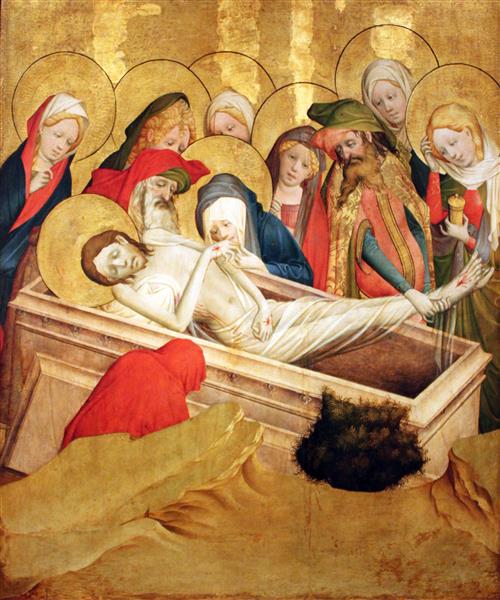 [/IMG]
Мастер Франке ок. 1380, «Положение во гроб», ок. 1430, р. 99×89 см., темпера, дуб – Master Francke (c. 1380), *The Entombment* (c. 1430), 99 × 89 cm, tempera on oak
Патетический и экспрессивный хоровод оплакивающих и поклоняющихся Христу – A passionate and expressive circle of those mourning and worshipping Christ
[IMG] [/IMG]
Алвару Пиреш де Эвора, ок 1390 ок. 1450, «Дева с младенцем и ангелы», ок. 1430, темпера на доске, р. 231×135 см., Италия, Пиза, интернациональная готика, проторенессанс - Álvaro Pires de Évora (c. 1390 – c. 1450), *Virgin and Child with Angels*, c. 1430, tempera on panel, 231 × 135 cm, Italy (Pisa), International Gothic, Proto-Renaissance
Формальность, декоративность, экспрессия ангелов с музыкальными инструментами, поющих славу деве с младенцем - The stylization, decorative quality, and expressiveness of the angels with musical instruments singing the praises of the Virgin and Child
[IMG]
загрузить изображение для техподдержки[/IMG]
Фра Анджелико, 1395-1455, «Страшный суд», 1431, панель, темпера, 105х210 см., Сан Марко, «раннее возрождение» - Fra Angelico, 1395–1455, *The Last Judgment*, 1431, panel, tempera, 105 × 210 cm, San Marco, Early Renaissance
Дидактизм, ригоризм, рационализм, условное членение на три части – Христос со святыми, праведники и грешники; множество дробных, реалистичных и тщательно выписанных персонажей – Didacticism, rigorism, rationalism, a conventional division into three parts—Christ with the saints, the righteous, and the sinners—and a multitude of distinct, realistic, and meticulously rendered figures
[IMG][IMG] [/IMG][/IMG]
Рогир ван дер Вейден, ум. 1464, «Св. Георгий и змей», 1432-1435, Фландрия, доска, масло, р. 14,3×10,5 см., «северное возрождение» – Rogier van der Weyden (d. 1464), *Saint George and the Dragon*, 1432–1435, Flanders, oil on panel, 14.3 × 10.5 cm, Northern Renaissance
Динамика и решительность, символизм и условность композиции, сочетающиеся с тщательностью и реализмом выполнения деталей - Dynamism and decisiveness, symbolism and compositional stylization, combined with meticulousness and realism in the execution of details
[IMG] [/IMG]
Фра Анджелико ок. 1395-1455, «Мученичество Св. Марка», ок. 1433, панель, темпера, р. 39×56 см., Сан Марко – Fra Angelico c. 1395-1455, "Martyrdom of St. Mark", c. 1433, panel, tempera, r. 39×56 cm., San Marco
Агрессия толпы, драматизм и жестокость, чудо, гроза, град и тьма в разгар дня, мучители в страхе разбегаются - Mob aggression, high drama and brutality, a miracle, a thunderstorm, hail, and darkness in the middle of the day—tormentors scattering in fear
[IMG] [/IMG]
Ян ван Эйк, 1385-90 -1441, «Мужчина в тюрбане. Предположительно автопортрет», масло по дубу, р. 26×19 см., 1433, Брюгге – Jan van Eyck (1385/90–1441), *Portrait of a Man in a Turban (Presumably a Self-Portrait)*, oil on oak, 26 × 19 cm, 1433, Bruges
Драматическая взволнованность головного убора, трезвость, жесткость и проницательность взгляда, направленного на собеседника и на окружающий мир, вера в себя, активность и рациональность - The dramatic intensity of the headdress; the sobriety, sternness, and keenness of the gaze directed at the interlocutor and the world around; self-confidence, dynamism, and rationality
[/IMG]Мазаччо 1401-1428, «Чудо со статиром». Часовня Бранкаччи, !425, Италия, фреска, раннее возрождение - Masaccio (1401–1428), *The Tribute Money*. Brancacci Chapel, 1425, Italy, fresco, Early Renaissance
На суровом, монохромном фоне многоцветная, декоративная, условно и формально выполненная, жестикулирующая группа, ей противостоят реалистически написанные, сливающиеся с пейзажем, боковые фигуры - Set against a stark, monochrome background is a multicolored, decorative group of gesturing figures—rendered in a stylized, formal manner—contrasted with realistically painted peripheral figures that blend into the landscape
[IMG]http:
//[/IMG]Мазаччо 1401-1428, «Апостол Павел», 1426, Италия, раннее возрождение, религиозная живопись - Masaccio (1401–1428), *Apostle Paul*, 1426, Italy, Early Renaissance, religious painting
Сила духа, острота меча, резкая энергия и экспрессия складок одежды, подчеркнутых световым контрастом - Strength of spirit, the sharpness of the sword, and the vigorous energy and expressiveness of the garment's folds, accentuated by the contrast of light
[IMG]ht
tp://[/IMG]Мазаччо 1401-1428, «Мученичество Иоанна Крестителя», 1426 «, Италия, темпера, часть панели, 21 x 43,8 см., религиозная живопись - Masaccio (1401–1428), *The Martyrdom of John the Baptist* (1426), Italy, tempera, panel fragment, 21 x 43.8 cm, religious painting
Агрессия, жестокость, драматизм, экспрессия, цветовой и световой контраст, динамика действия - Aggression, cruelty, drama, expressiveness, contrast of color and light, dynamic action
[IMG]
[/IMG]Мазаччо 1401-1428, «Распятие святого Петра», 1426, часть полиптиха - Masaccio (1401–1428), *The Crucifixion of Saint Peter*, 1426, part of a polyptych
Жестокость, суровость, экспрессия, будничность и неумолимость исполнителей - The cruelty, severity, expressiveness, matter-of-factness, and relentlessness of the performers
[IMG]
[/IMG]Андрей Рублев ок. 1360 ок. 1427, «Положение во гроб», 1425-1427, работа для иконостаса Троицкого собора Троице-Сергиева монастыря, Россия - Andrei Rublev (c. 1360–c. 1427), *The Entombment*, 1425–1427, created for the iconostasis of the Trinity Cathedral at the Trinity-St. Sergius Monastery, Russia
Экспрессия, оплакивание, патетика, эмоциональный подъем - Expressiveness, lamentation, pathos, emotional uplift
[IMG]
[/IMG]Мазаччо 1421-1428, «Изгнание Адама и Евы из рая», фреска, р. 208 × 88 см., ок. 1427, Италия, капелла Бранкаччи - Masaccio (1421–1428), *The Expulsion of Adam and Eve from Paradise*, fresco, 208 × 88 cm, c. 1427, Italy, Brancacci Chapel
Экспрессия, меч в руке ангела, жесткость и неумолимость, дидактичность, ригоризм и рационализм - Expressiveness, the sword in the angel's hand, harshness and implacability, didacticism, rigorism, and rationalism
[IMG]
картинка по ссылке для сайта[/IMG]
Донателло 1386-1466, «Пир Ирода», 1427, рельеф и горельеф, бронза, Флоренция - Donatello 1386-1466, "Herod's Feast", 1427, relief and high relief, bronze, Florence
Смятение, всплеск эмоций, динамика, экспрессия группы, охваченность единым чувством, конвульсивный трепет физического мира - Turmoil, a surge of emotion, dynamism, the group's expressiveness, a shared all-consuming feeling, the convulsive trembling of the physical world
[IMG]
[/IMG]Мазолино да Паникале 1383- ок. 1447, «Мученичество св. Екатерины», 1428, фреска, Сан Клементе, Рим – Masolino da Panicale (1383–c. 1447), *The Martyrdom of St. Catherine*, 1428, fresco, San Clemente, Rome
Ангел разрушает колеса жестокого и бездушного механизма для пыток – An angel destroys the wheels of a cruel and soulless torture mechanism
[IMG]
[/IMG]Ян ван Эйк, 1385-90 -1441, «Христово воинство», 1427-30, панель Гентского алтаря, р. 145×51 см., «северное возрождение» - Jan van Eyck (1385/90–1441), *The Soldiers of Christ* (1427–30), panel from the Ghent Altarpiece, 145 × 51 cm, Northern Renaissance
Движение вперед ради защиты великих христианских идеалов добра и справедливости – Moving forward to defend the great Christian ideals of goodness and justice
[IMG]
[/IMG]Мастер Франке ок. 1380, «Положение во гроб», ок. 1430, р. 99×89 см., темпера, дуб – Master Francke (c. 1380), *The Entombment* (c. 1430), 99 × 89 cm, tempera on oak
Патетический и экспрессивный хоровод оплакивающих и поклоняющихся Христу – A passionate and expressive circle of those mourning and worshipping Christ
[IMG]
[/IMG]Алвару Пиреш де Эвора, ок 1390 ок. 1450, «Дева с младенцем и ангелы», ок. 1430, темпера на доске, р. 231×135 см., Италия, Пиза, интернациональная готика, проторенессанс - Álvaro Pires de Évora (c. 1390 – c. 1450), *Virgin and Child with Angels*, c. 1430, tempera on panel, 231 × 135 cm, Italy (Pisa), International Gothic, Proto-Renaissance
Формальность, декоративность, экспрессия ангелов с музыкальными инструментами, поющих славу деве с младенцем - The stylization, decorative quality, and expressiveness of the angels with musical instruments singing the praises of the Virgin and Child
[IMG]
загрузить изображение для техподдержки[/IMG]
Фра Анджелико, 1395-1455, «Страшный суд», 1431, панель, темпера, 105х210 см., Сан Марко, «раннее возрождение» - Fra Angelico, 1395–1455, *The Last Judgment*, 1431, panel, tempera, 105 × 210 cm, San Marco, Early Renaissance
Дидактизм, ригоризм, рационализм, условное членение на три части – Христос со святыми, праведники и грешники; множество дробных, реалистичных и тщательно выписанных персонажей – Didacticism, rigorism, rationalism, a conventional division into three parts—Christ with the saints, the righteous, and the sinners—and a multitude of distinct, realistic, and meticulously rendered figures
[IMG][IMG]
[/IMG][/IMG]Рогир ван дер Вейден, ум. 1464, «Св. Георгий и змей», 1432-1435, Фландрия, доска, масло, р. 14,3×10,5 см., «северное возрождение» – Rogier van der Weyden (d. 1464), *Saint George and the Dragon*, 1432–1435, Flanders, oil on panel, 14.3 × 10.5 cm, Northern Renaissance
Динамика и решительность, символизм и условность композиции, сочетающиеся с тщательностью и реализмом выполнения деталей - Dynamism and decisiveness, symbolism and compositional stylization, combined with meticulousness and realism in the execution of details
[IMG]
[/IMG]Фра Анджелико ок. 1395-1455, «Мученичество Св. Марка», ок. 1433, панель, темпера, р. 39×56 см., Сан Марко – Fra Angelico c. 1395-1455, "Martyrdom of St. Mark", c. 1433, panel, tempera, r. 39×56 cm., San Marco
Агрессия толпы, драматизм и жестокость, чудо, гроза, град и тьма в разгар дня, мучители в страхе разбегаются - Mob aggression, high drama and brutality, a miracle, a thunderstorm, hail, and darkness in the middle of the day—tormentors scattering in fear
[IMG]
[/IMG]Ян ван Эйк, 1385-90 -1441, «Мужчина в тюрбане. Предположительно автопортрет», масло по дубу, р. 26×19 см., 1433, Брюгге – Jan van Eyck (1385/90–1441), *Portrait of a Man in a Turban (Presumably a Self-Portrait)*, oil on oak, 26 × 19 cm, 1433, Bruges
Драматическая взволнованность головного убора, трезвость, жесткость и проницательность взгляда, направленного на собеседника и на окружающий мир, вера в себя, активность и рациональность - The dramatic intensity of the headdress; the sobriety, sternness, and keenness of the gaze directed at the interlocutor and the world around; self-confidence, dynamism, and rationality
Григорий Нестеров © 29.09.2026
© Все права принадлежат автору. Цитирование с указанием источника
FAITH, DETERMINATION, UNCOMPROMISING SPIRIT
A DECADE OF ACTION 1425-1434 (3)
A DECADE OF ACTION 1425-1434 (3)
This is the third decade in a recurring 60-year cycle of shifting public moods. We previously examined this in the article "Turbulent Decades (3)," published in late 2024 on the *Forum* blog (https://forum.artinvestment.ru/blog.php?b=366601). It is a particularly turbulent decade, notable for hosting the world-altering events of the French Revolution (occurring in the first instance and again 60 years later: 1785–1794 and 1845–1854), as well as the epoch-defining two decades of the Russian (and international) "first" and "second avant-garde" (a term coined by M. Grobman)—1905–1914 and 1965–1974.
(The number in parentheses—(3)—indicates the decade's position within the 60-year cycle. The cycle begins with an "active" decade and concludes with a "meditative" one. There are three "active" decades—(1), (3), and (5), corresponding to odd numbers—and an equal number of "meditative" decades—(2), (4), and (6), corresponding to even numbers.)
All "active" (avant-garde) decades (3)
"Rational" supercycles are marked in blue
"Sensual" ones in black
"Summer" stage (1405-2004)
1425-1434 1485-1494
1545-1554 1605-1614
1665-1674 1725-1734
1785-1794 1845-1854
1905-1914 1965-1974
"Autumn" stage (2005-2604)
2025-2034 2085-2094
"Sensual" ones in black
"Summer" stage (1405-2004)
1425-1434 1485-1494
1545-1554 1605-1614
1665-1674 1725-1734
1785-1794 1845-1854
1905-1914 1965-1974
"Autumn" stage (2005-2604)
2025-2034 2085-2094
I return to the topic of the "avant-garde" (3)—those "active," "turbulent," and "dynamic" decades—given its continued relevance; for the second year running, we have been not merely contemporaries and witnesses but also participants in the unfolding drama and comedy of this unique period.
Here, as before, art in general—and painting in particular—must be viewed not merely as enlivening illustrative material, but as something fundamental, without which we cannot comprehend historical time.
It must be noted, however, that painting holds a vast—virtually infinite—array of meanings and connotations; thus, we cannot do without some prior knowledge, a key or a clue, and a way to distill the material. To this end, I employ a translation of the painting into verbal language, which allows us to identify, juxtapose, and compare hidden meanings, thereby significantly simplifying our task.
Now, having viewed the paintings shown below, let us compare them with the "meditative" decade of 1415–1424 that has just passed—a period characterized by "silence, meditation, inward focus, harmony, beauty, peace and humility, acceptance of reality, emotional truth, tenderness, refinement and musicality, and the subtlety and airiness of colors," all of which found expression in Andrei Rublev’s famous *Trinity*.
The Meditative, Contemplative Decade (2) https://forum.artinvestment.ru/blog.php?b=367481
During the decade in question, both the subject matter of his work—*The Entombment*—and its stylistic qualities undergo a transformation, characterized by "expression, lamentation, pathos, and emotional intensity." Yet, we can explain this shift through the pattern—already familiar to us—of alternating "meditative" and "active" decades. Indeed, we can further confirm the validity of this alternating pattern by comparing the work with his earlier *Virgin* (1408)—a piece marked by "expression, outward impulse, generalization, emotion, and movement"—which belongs to the first (1) "active" decade of the 1405–1414 sixty-year cycle.
A Decade of Russian Painting (1): 1405–1414 https://forum.artinvestment.ru/blog.php?b=367081
We are already familiar with the phenomenon of alternating "active" and "meditative" decades. What interests us now is the specific nature of the differences between the "active" decades. Here, the work of Andrei Rublev offers a particularly useful example, as he is represented in all three periods—including the two "active" ones: the first (1405–1414) and the third (the one currently under discussion). Although both works are equally active and expressive, the distinction between them is striking. In the nearly monochrome fresco from the first decade (1), the Virgin—in the context of the *Last Judgment*—turns to Jesus Christ as the intercessor for all, that is, for humanity in the abstract and impersonal sense. Her movement is highly generalized and detached, directed toward God—the invisible Absolute. Despite the dynamic quality shared by both pieces, his second work—*The Entombment*, created twenty years later—differs radically in its warmth, poetic quality, and the power of immediate, personal presence, lived experience, and faith. In short, the perspective in the first decade (1) is supra-personal, detached, and rational, whereas in the third decade (3), it is individual, personal, and sensory—rooted in the here and now. We can further confirm the validity of this observation by looking at another instance: the presence of Donatello’s sculptures across the two decades in question. If the youthful *David*—with Goliath’s disproportionately large severed head at his feet, created during the first (1) "active" decade of 1405–1414—gives the impression of a somewhat awkwardly posing twenty-year-old boy (the artist himself was twenty-three at the time) casting himself as an unreal, invincible hero—an act of clear idealization and detached, cool rationalization—then the *Feast of Herod* bas-relief, executed in 1427 (again, twenty years later!) during another "active" decade (3), transports us into a world that is not merely "warm" but white-hot: a realm of personal, immediate, sensual, and real—rather than ideal—existence, characterized by "turmoil, a surge of emotion, dynamism, group expression, a shared all-consuming feeling, and the convulsive trembling of the physical world." As we can see, these two "active" decades clearly reveal an alternation in artistic style: a shift from the "impersonal," "detached," "rational," and "ideal" mode of perceiving reality in the first instance (1) (1405–1414) to a "personal," "sensuous," and "subjective" one in the second (3) (1425–1434). So, we have examined two of the three "active" decades of the 60-year cycle. The next one—number (5)—spans the years 1445–1454. By looking into this period, we can understand not only the specific character of this final "active" decade but also how these decades relate to one another. Donatello—a figure already familiar to us—helps illustrate this through his *Equestrian Statue of Gattamelata* (1446–1453), the first large-scale equestrian monument created in Europe since antiquity. It is worth noting that Donatello stands out as a prime example of a truly dynamic creative spirit; we can witness his art undergoing yet another radical transformation. This time, we do not see the "pulsation and seething energy of sensory reality"; instead, the movement of horse and rider is governed by an iron, rational, and indomitable will. The composition is precise and structured; the horse’s rhythmic gait is relentless, dictated by the rider’s logic, discipline, rules, and the laws of nature. Strikingly similar in style is a fresco from the same decade by Mantegna—*The Procession of St. James to Execution* (known today only through photographs)—which shares the same dramatic low-angle perspective (applied to both figures and architecture), sense of monumentality, steady procession pace, and the rigid, rational delineation of buildings. I also invite you to look at the work I have chosen as the avatar for the article on this decade: Jean Fouquet’s *Virgin and Child* (1450). It is characterized by a distinct "formalism, a contrasting blend of realism and the stylized nature of the background’s vivid details, a provocatively exposed breast, and a rational rigidity and precision of line."
All this allows us to assert that within the first 60-year cycle of the "Summer" phase under consideration, an alternation of stylistic character occurs across its three "active" decades, following this pattern:
1. Decade (1) (1405–1414): style — "impersonal," "detached," "rational," "ideal"
2. Decade (3) (1425–1434): style — "personal," "sensual," "subjective"
3. Decade (5) (1445–1454): style — "impersonal," "detached," "rational," "ideal"
Does this alternation persist in other cycles? We will examine this in future articles…
Active post-avant-garde decades (5) https://forum.artinvestment.ru/blog.php?b=366721
It should be noted that the qualities alternating within the cycles are not viewed as absolute, but rather in relation to one another—as "dominant" or "predominant" (for example, the 600-year "Summer" stage generally possesses a "rational" character compared to the "Autumn" stage; it comprises five 120-year hypercycles that alternate between a predominance of "rational" character—or style—and "sensual" character, and so on).
1425–1434 – Active decade (of the first sixty-year period of the 120-year rational supercycle) (3)
Masaccio – Early Renaissance, religious painting, (1425) "Against a stark, monochrome background, a multicolored, decorative, stylized, and formally rendered group in expressive poses" – (1426), "Strength of spirit, the sharpness of the sword, the intense energy and expressiveness of garment folds highlighted by the contrast of light and shadow," "Aggression, cruelty, drama, expressiveness, contrasts of color and light, dynamic action," "Cruelty, severity, expressiveness, the matter-of-factness and implacability of the executioners" – (1427), Rublev, "Expressiveness, lamentation, pathos, emotional intensity" – Masaccio, "The Expulsion from the Garden of Eden," "Expressiveness, the sword in the angel's hand, harshness and implacability, didacticism, rigorism, and rationalism" – Donatello, "The Feast of Herod," "Turmoil, a surge of emotion, dynamism, the expressiveness of the group, a shared emotion gripping all, the convulsive trembling of the physical world" – (1428), Masolino, "Laconism, starkness of color, harshness, sharply defined architectural lines" – (1430), Jan van Eyck, "Forward movement in defense of the great Christian ideals of goodness and justice" – Francke, "A poignant and expressive circle of mourners and worshippers of Christ" – Álvaro Pires, "Formality, decorativeness, the expressiveness of angels with musical instruments singing the praises of the Virgin and Child" – (1431), Fra Angelico, "The Last Judgment," "Didacticism, rigorism, rationalism, a multitude of small figures, realism and conventionality” – (1433), Rogier van der Weyden, “dynamism and decisiveness, symbolism and conventionality, meticulousness and realism of detail” – Fra Angelico, “mob aggression, drama and cruelty, a miracle, a storm, hail and darkness in midday, tormentors scattering in fear” – Jan van Eyck, “dramatic agitation of the headdress, sobriety, sternness and keenness of the gaze directed at the interlocutor and the surrounding world, self-confidence, dynamism and rationality”
Historical Background:
1425 – (Rus') (post-1425) – Civil War (20 years) – Rus', plague epidemic (1425–27) – Hussite Wars (1420–34) – Switzerland (Appenzell Wars) (1401–29) – France (Civil War between Armagnacs and Burgundians) (1407–35) – Turkish-Venetian War (1423–30) – Italy (Wars in Lombardy) (1425–54) – Royalist coup by James I in Scotland (1425) – Hundred Years' War between England and France (1337–1453) (116 years) (including the Lancastrian phase, 1415–53) – 1426 – England, "Parliament of Bats" (ban on carrying weapons) – Dano-Hanseatic War (until 1435) – Vytautas's campaign against Pskov – Victory of the Taborites at Aussig (Hussites) – 1427 – Bern (Inquisition in Switzerland), first "witch-hunt" trials, expulsion of the Jewish community – Hussites routed the Crusaders – Lithuania seized Tula – Plague in Rus' – Tours (France), start of cathedral construction (Flamboyant Gothic) – Conquest of the Viet people by China – 1428 – Joan of Arc, idea of liberating the country (Siege of Orléans by the English) (until 1429) – End of the civil war in Morocco (begun in 1420) – Formation of the Uzbek Khanate – Formation of the Crimean Khanate (by 1430) – Russia, end of the plague epidemic (from 1417) – Samarkand, construction of the observatory by Ulugh Beg – 1429 – (France) – Joan of Arc (hears voices) – Patriotism. Under her leadership, the French achieve victory (an episode of the Hundred Years' War, 1337–1453) – Siege of Orléans lifted (begun in 1428) – Switzerland: Appenzell Wars end (begun in 1401) – Crusades against the Hussites (1420–1434) – Rus': raids by the Golden Horde – (Paris) – a sermon preached for ten consecutive days (at the Cemetery of the Innocents, near a "Danse Macabre" depiction, against a backdrop of piled skulls) – 1430 – Capture of Joan of Arc – Hussite victory over Sigismund's army – (Poland) – the throne becomes elective – Lithuania: death of Vytautas – Rus': extreme drought, massive forest and peat fires, widespread famine – Rus': Prince Yuri Dmitrievich opposes Vasily II the Blind and occupies Novgorod – Peasant uprisings in Transylvania and Northern Hungary – Council of Florence – "Dante Readings" begin – 1431 – (France) – Burning of Joan of Arc by the English – (Hundred Years' War between England and France, 1337–1453) – Collapse of the Fifth Crusade against the Hussites – Bakota Uprising (Ukraine) against Lithuanians and Poles (until 1434) – Polish-Teutonic War (until 1435) – Uprising in Galicia (Spain) (until 1435) – Council of Basel (1431–1449) (Switzerland): settlement of the Hussite Wars, church reform – Lithuania, alliance with the Teutonic Order – Polish attack on Volhynia – Golden Horde settles disputes over princely rule in Rus' – Italy, Lorenzo Valla, treatise *On Pleasure* – 1432 – Bakota Uprising (1431–34) – Uprising in Galicia (1431–35) – Polish-Teutonic War (1431–35) – Albanian uprising against the Ottomans (until 1436) – Lithuania, outbreak of Civil War (until 1438) – Sigismund becomes Grand Duke of Lithuania following a conspiracy – Alliance between Lithuania and Poland – Devastation of Ryazan by the Crimean Khan – 1433 – First Crimean Khan, Hacı Giray (until 1434) – Exile of Cosimo de' Medici from Florence – Formation of the Great Horde in the Lower Volga region – Seizure of power in Moscow by Yuri Dmitrievich – Return of Vasily II the Blind to Moscow; boyar I. D. Vsevolozh blinded for treason – 1434 – End of the Hussite Wars (begun 1419), defeat of the Taborites (followers of Hus) – End of the Crusades against the Hussites (begun 1420) – Podolia: suppression of the Bakota Uprising against Polish-Lithuanian feudal lords (begun 1431) – Uprising in Galicia against the nobility (1431–35) – Polish-Teutonic War (1431–35) – Transylvanian peasant uprising (Romania, Carpathians) (1434–35) – Uprising in Sweden (1434–36) – Brothers Ilia I and Stephen II: struggle for the Moldavian principality – Lithuania, Civil War (1332–1338) – Civil strife in Moscow
1428 – Switzerland, witch trials in Valais – An accusation by three or four neighbors was sufficient grounds for arrest and torture. Unlike in later centuries, two-thirds of the accused and executed were men rather than women. In the first eighteen months alone, between 100 and 200 people were burned at the stake in the region. Accusations included flying through the air, shape-shifting, stealing wine from cellars, and conspiring with the Devil.
See the translations below the photographs after the Russian table of contents
Gregory Nesterov © 18-29.09.2026
© All rights reserved by the author. Citations must be cited with attribution.
Энергия света и любви, активное - 1485-1494 (3) Energy of light and love, active - https://forum.artinvestment.ru/blog.php?b=367931
Вера, решимость, бескомпромиссность 1425-1434 (3) Активные (бурные) десятилетия https://forum.artinvestment.ru/blog.php?b=367911
Все медитативные, осмысляющие десятилетия - All the meditative, reflective decades https://forum.artinvestment.ru/blog.php?b=367841
Мир любви, красоты и гармонии". Медитативное десятилетие 2015-2024 (2) -A World of Love, Beauty, and Harmony." Meditative Decade 2015-2024 (2) - https://forum.artinvestment.ru/blog.php?b=367771
[COLOR="DarkGreen"Концептуальность и имматериальность мира. Медитативное (2) 1955-1964[/COLOR] https://forum.artinvestment.ru/blog.php?b=367751
Символизация, отстранение, обобщение 1895-1904 (2) - Symbolization, detachment, generalization 1895-1904 (2) https://forum.artinvestment.ru/blog.php?b=367711
Принятие чувственной реальности. Медитативное десятилетие 1835-1844 (2) - Acceptance of Sensual Reality. The Meditative Decade 1835–1844 (2) https://forum.artinvestment.ru/blog.php?b=367691
Погружение в атмосферу чувственной жизни - Immersion in the Atmosphere of Sensual Life. The Meditative Decade 1775–1784 (2) https://forum.artinvestment.ru/blog.php?b=367621
Мир мечты поэзии и легкой меланхолии. Медитативное десятилетие 1715-1724 (2) - A dream world of poetry and light melancholy. The meditative decade 1715–1724 (2) https://forum.artinvestment.ru/blog.php?b=367581
Отрезвление и объективация. Медитативное десятилетие 1655-1664 (2) - Sobriety and Objectification. The Meditative Decade 1655–1664 (2) https://forum.artinvestment.ru/blog.php?b=367541
Отдых, отвлечение и развлечение. Медитативное десятилетие 1595-1604 (2) - Rest, Distraction, and Entertainment. The Meditative Decade 1595–1604 (2) https://forum.artinvestment.ru/blog.php?b=367521
Экзистенциальное переживание. Медитативное десятилетие 1535-1544 (2) Existential Experience. A Meditative Decade https://forum.artinvestment.ru/blog.php?b=367501
Поиски истины, гармонии и красоты. Медитативное десятилетие 1475-1484 (2) The Search for Truth, Harmony, and Beauty: A Meditative Decade https://forum.artinvestment.ru/blog.php?b=367491
Медитативное осмысляющее десятилетие 1415-1424 (2) A Meditative Reflective Decade https://forum.artinvestment.ru/blog.php?b=367481
Ссылки на все начальные (1) активные десятилетия этапа «Лето», (синим цветом выделен «рациональный» суперцикл, черным – «чувственный»):
Links to all initial (1) active decades of the “Summer” stage (the “rational” supercycle is highlighted in blue, the “sensual” one in black):
Десятилетие русской живописи (1) - 1405-1414 (активное) (active) - Decade of Russian Painting https://forum.artinvestment.ru/blog.php?b=367081
Активное десятилетие, агрессия (1) - 1465-1474 годов - Active decade, aggression https://forum.artinvestment.ru/blog.php?b=367101
«Маньеризм» (1), активное десятилетие (1525-1534 годов) - Mannerism" (1), active decade https://forum.artinvestment.ru/blog.php?b=367131
Маньеризм, Барокко (1) активное десятилетие (1585-1594) Mannerism, Baroque (1) active decade https://forum.artinvestment.ru/blog.php?b=367161
Классицизм и рационализм. (1) Активное десятилетие 1645-1654 Classicism and rationalism. (1) Active decade https://forum.artinvestment.ru/blog.php?b=367191
Рококо, мир любви. (1) Активное десятилетие 1705-1714 Rococo, the world of love. (1) Active decade https://forum.artinvestment.ru/blog.php?b=367221
Чувство, эмоция, романтизм. (1) Активное десятилетие 1765-1764 Feeling, emotion, romanticism. (1) Active decade https://forum.artinvestment.ru/blog.php?b=367241
Жажда нового, романтизм. (1) Активное десятилетие 1825-1834 Thirst for the new, romanticism. (1) Active decade https://forum.artinvestment.ru/blog.php?b=367251]
Рациональность, негативизм, модерн. (1) Активное десятилетие 1885-1894 Rationality, negativism, modernity. (1) Active decade https://forum.artinvestment.ru/blog.php?b=367271
Экспрессия, радикализм. (1) Активное десятилетие 1945-1954 Expression, radicalism. (1) Active decade https://forum.artinvestment.ru/blog.php?b=367321
+ Этап «Осень» (носит общий чувственный характер):
+ The “Autumn” stage (has a general sensory character):
Явление мира. (1) Активное десятилетие 2005-2014 The phenomenon of peace. (1) Active decade https://forum.artinvestment.ru/blog.php?b=367401
Все активные десятилетия (1) All active decades https://forum.artinvestment.ru/blog.php?b=367451
Медитативные (срединные) десятилетия (6) Meditative (middle) decades https://forum.artinvestment.ru/blog.php?b=367021
MEDITATIVE (MIDDLE) DECADES (60-year cycle of meditative decades (6)) https://forum.artinvestment.ru/blog.php?b=367031
Активные пост авангардные десятилетия (5) Active post-avant-garde decades https://forum.artinvestment.ru/blog.php?b=366721
Пост-авангардные десятилетия (60-летний цикл медитативных десятилетий) (4) Post-avant-garde decades (60-year cycle of meditative decades)https://forum.artinvestment.ru/blog.php?b=366651
Бурные десятилетия (3) Turbulent Decades https://forum.artinvestment.ru/blog.php?b=366601
THE BURNING DECADES (3) https://forum.artinvestment.ru/blog.php?b=367051
Восьмидесятилетие окончания Второй Мировой Войны - Eightieth anniversary of the end of World War II https://forum.artinvestment.ru/blog.php?b=366941
Часы истории. Ритмы мировой культуры - The Clock of History: Rhythms of World Culture file:///C:/Users/user/Desktop/Часы%20Истории.PDF
Ритмы мировой культуры - Rhythms of World Culture - https://forum.artinvestment.ru/blog.php?b=263461
Предметность и беспредметность (глобальные циклы мировой культуры) - Representationalism and non-representationalism (global cycles of world culture) https://forum.artinvestment.ru/blog....0791&goto=next
Выставка живописи Г. Нестерова "TABULA RASA" - Exhibition of paintings by G. Nesterov "TABULA RASA" https://forum.artinvestment.ru/blog.php?b=367311
Всемирная выставка живописи https://forum.artinvestment.ru/blog.php?b=354021
Группа Мир Культуры - World of Culture https://www.facebook.com/groups/321408011981360/
Всего комментариев 0


